Mother Bear at the Door
When we first began the fly fishing operation on the Yokanga River nearly twenty years ago, I felt I understood something that the others hadn’t yet managed to grasp. If we were going to offer something truly rare, we had to preserve it, maintain its essence and share it with others. This had to be our priority. The Yokanga is not a place redesigned for comfort; its remoteness defines everything, from the vast stretches of tundra and low birch forest that the river runs through, to the hundreds of miles of distance from cities and roads. It does not adapt to us; we have to adapt to it.
In those early days, when operations first began, nothing about the river suggested that time had passed at all. The thin wind carried distant cries from terns and gulls skimming above the water. The banks held their shape and the current moved with the same patient clarity it always had. From what we could tell, it was completely unchanged from what we had first experienced. It was in the mornings that something started to feel misaligned: gravel that had settled cleanly the evening prior now lay disturbed; the next morning, a boot print appeared where no one had walked. It was the small adjustments made in our usual arrangement of things that began to spark concern.
It didn’t take long for us to realise that someone had been moving through the river, in the dark hours of the night. The poachers came quietly and undetected, they appeared to move through the river system the same way that animals would move through wild country. It was clear they knew the Yokanga well, hunting in the dark pockets of water where fish liked to rest, or using the narrow seams of the current where the nets could be removed as quickly as they were set. Most importantly of all, they knew when the guides and fishermen would leave the river unattended.
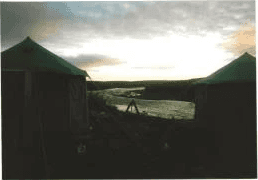
If we wanted the Yokanga to remain a sanctuary, our presence alone would not be enough. We began looking for ways to protect the river more effectively, positioning dedicated river guards at strategic stretches along its course. We established a permanent post on one of the most productive parts of the system, the waterfall beat on the lower section. The steel containers that had once carried supplies from Canada were given a new purpose, transformed into simple shelters for the guards. They soon adapted to the river’s quiet cycles, sleeping through the day and patrolling through the night, during the poachers’ busiest hours.
For a while, that balance held, until the river decided to remind us that it moved according to rhythms far older than anything we had built beside it.
After a long night patrol, two inspectors returned towards their containers at first light. They walked across tundra still covered by a thin layer of mist, the crisp ground beneath them crackling slightly as the overnight frost gave way under their boots.
As they reached the clearing, one of the guards slowed.
In the doorway of one of their small homes stood a large female bear.
She filled the entrance, her broad shoulders pressed against the frame of the container. She stood there growling softly at the guards, the low hums vibrating through the cold morning air. Not loud. Not frantic. Just deliberate.
The bear had clearly taken a liking to their small shelter, enjoying the warmth that lingered inside the metal walls. She shifted slightly, settling further into the doorway as if confirming her decision.
The inspectors stopped moving, trying to remain as still as physically possible. They had learned that in places like the Yokanga, sudden motion means very little. Animals respond to space, patience, and stillness. They began to step backwards slowly, one careful movement at a time, keeping their distance from the entrance. Their breathing slowed as they moved, their hands kept loose at their sides, trying not to signal anything that might be interpreted as threat or panic.
When they were far enough away, one of the inspectors reached slowly for the satellite telephone. His hand moved carefully but deliberately; he knew his every move was being watched. He managed to press the numbers quietly, waiting for the signal to connect before speaking into the receiver.
The solution was again practical.
They would wait.
There was no confrontation, no attempt to force her from the structure. In wild places, solutions moved slower than human urgency preferred. The river, the land, and the animals that moved through it understood space differently.
It was the lodge manager who decided that sending the large MI-16 helicopter would be the safest way to guide her away without causing harm.
Soon, the steady rhythm of helicopter motors travelled across the valley. The MI-16 moved low over the river before slowing above the container, its presence heavy but controlled. The pilot held the aircraft in a steady hover. The downdraft shook the container walls, rattling the steel panels and scattering loose dust and grass across the clearing. The noise and movement disturbed the quiet morning air.
The bear emerged.
She stepped out slowly, growling low in her throat, her attention immediately fixed on the helicopter above her. The sound of the rotors did not appear to frighten her. It irritated her.
She stood there, broad and unmoving, growling steadily at the helicopter as if challenging it to remain. She began throwing her fists in the air as if hoping to catch it and bring the helicopter plummeting down. The pilot noticed her determination and began to move slowly away from the container, keeping just enough distance to encourage her to follow, rather than force her to move. And she did.
They travelled across open tundra, helicopter and bear, neither one of them panicked, neither reckless. The helicopter drifted steadily forward, guiding her farther from the river outpost, deeper into the wide open land where the horizon remained unbroken. The bear followed on foot, moving with deliberate persistence. Her determination and resilience were astonishing, the way she was able to maintain a few metres’ distance from this loud growling machine, with no signs of turning back or giving up. Wherever the helicopter moved, you would hear the bear growling occasionally beneath the engine’s roars.
They travelled many kilometres into the tundra. The wind from the rotors scattered loose grass and dust across the pale ground, but the bear continued forward, focused on the aircraft above her rather than the land around her. It was not pursuit in anger. It was possession of space. She was simply refusing to give up ground quickly.
Once they were far enough from the outpost, the pilot pulled the aircraft higher into the sky and turned back towards the lodge. The roar of the engine faded slowly into the wide northern air until it became part of the wind itself.
Below, the bear slowed. Then she stopped.
She seemed confused, standing alone in the open landscape for a long moment before turning back towards the vastness from which she had come. She walked away slowly, her shape disappearing into the pale distance.
She did not return.
Later that day, the inspectors approached the container. Claw marks marked the doorway. Tracks circled the clearing before dissolving into tundra and wind. For a brief time, our outpost had simply blended back into the wilderness around it.
Wildness is not something that can be manufactured or advertised. It is something that is allowed to remain. It survives in places where distance is respected, where movement is careful. The Yokanga allows us to work beside it. To watch it. To protect it when we could.
And sometimes, if we were fortunate, to witness it remain exactly as it once was.
Written by Ciara Hart Gonzalez